
Regular technicals
Support
By: Grant Laidlaw
Welcome to the Solutions page
Many people ask for assistance in understanding the theoretical and practical aspects of the industry. I will endeavour to enlighten. We are going back to basics, as I have questions coming in that indicate that the basic understanding necessary to work in industry is not in place.
Prince asks: I need to understand the situation around natural refrigerants. Also, what is TEWI and forever Refrigerants? I do not see any natural refrigerants being used. Thank you.
Hi Prince, yes, I can assist you with your question and pick up from the last issue.
Natural refrigerants are currently being extensively used. The domestic refrigeration sector has moved over to R600a (Isobutane). R600a is a hydrocarbon and is, in fact, a natural refrigerant, as is R290 (Propane). In the light commercial refrigeration sector, R290 beverage coolers have been introduced into the market with tens of thousands of these units currently in use in South Africa. In the industrial refrigeration sector, R717 (ammonia) is very common and has been used in South Africa for over one hundred years. R717 (CO2) has gained considerable traction in the commercial refrigeration space.
Prince, let us look at Natural refrigerants in more detail
Natural refrigerants – an overview
Natural refrigerants are substances that occur naturally in the environment. Natural refrigerants are composed of the elements hydrogen, oxygen, carbon and nitrogen and include hydrocarbons, carbon dioxide, ammonia, water and air (also called “the natural five”).
Natural refrigerants: The natural five
Refrigerant | Chemical structure | Refrigerant nomenclature | |
Hydrocarbons | propane | C3H8 | R290 |
propene | C3H6 | R1270 | |
isobutane | C4H10 | R600a | |
Carbon dioxide | CO2 | R744 | |
Ammonia | NH3 | R717 | |
Water | H2O | R718 | |
Air | N2, O2, Ar, CO2, others | R729 | |
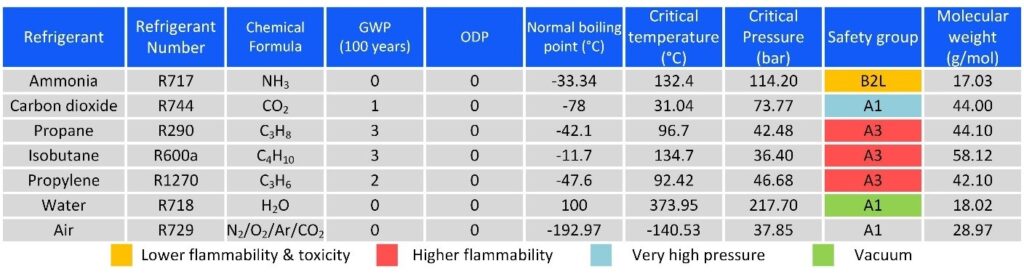
The strong advantages of natural refrigerants are that they have zero ODP and a zero or negligible GWP. For example, the GWP value for R717 is zero; R744, as the reference value for all other refrigerants, has a GWP of 1; and the group of hydrocarbons has a direct GWP between 2 and 3. As part of the natural biogeochemical cycles, natural refrigerants do not form persistent substances in the atmosphere, water or biosphere. Table 3 presents a summary of characteristics of natural refrigerants.
Table 3 Characteristics of natural refrigerants
Hydrocarbons
Hydrocarbons (HCs) are ideal as refrigerants, they are miscible with common refrigeration oils and their critical temperature is relatively high (R290 = 96.7°C; R1270 = 92.4°C; R600a = 134.7°C; compared to R22 = 96°C). In general, R600a, R290 and R1270 can be considered as the most prevalent hydrocarbon refrigerants, as well as several HC blends and ethane (R170). Pure hydrocarbon refrigerants exhibit relatively good efficiency (coefficient of performance) due to their favourable thermodynamic and transport properties (such as ratio of discharge to suction pressure, low liquid density, high specific heat, high thermal conductivity, low viscosity, etc.). Because of their lower molar mass/density, the refrigerant charge for a given cooling capacity tends to be much lower (a half or less) than with fluorinated refrigerants. However, all hydrocarbon refrigerants are highly flammable and thus necessary safety precautions need to be implemented.Isobutane (R600a)
R600a has a low saturated vapour pressure: 5 bar at +40 °C, compared to 10 bar for R134a and 18 bar for R404A. The low mass flow results in low pressure losses and high efficiency of the compressors, allowing the compressors to have a higher Coefficient of Performance (COP). R600a has its greatest success as a refrigerant in today’s more than 1000 million household refrigerators. It has been shown that refrigerators can be safely operated with hydrocarbons. Modern refrigerators are more efficient than ever and are quiet in operation due to the R600a properties. R600a is increasingly used in smaller commercial refrigeration systems, including beverage coolers and water dispensers.Propane (R290)
Propane has similar saturated vapour pressure to R22 and R404A. The compatibility of propane with common materials used in RAC installations and heat exchangers is given. Since 2000, internationally well-known manufacturers have offered compressors with R290. Using these new HC systems, energy savings of between 10% and 30% have been observed. Industries that are used to handling flammable substances have always used R290 and R1270 as refrigerants, often with large charge amounts. Recently, there have been more and more global corporations and manufacturers offering R290 as a refrigerant in commercial systems, commercial stand-alone units, as well as heat pumps and air-conditioners.First Blue Angel eco-label for R290 split AC
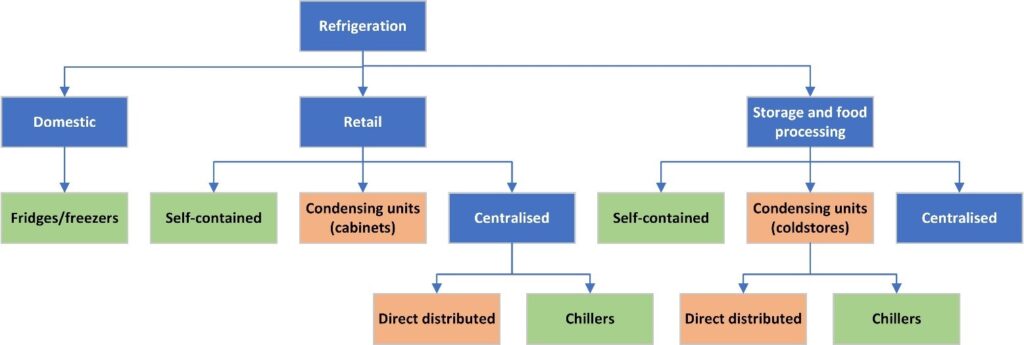
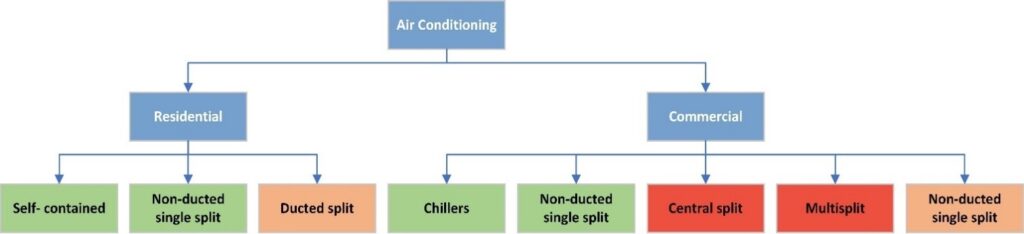
Air conditioners are designed to control the thermal comfort of living and working rooms and are especially used in those countries that regularly experience high outdoor temperatures. Midea’s residential split system air conditioner using R290 refrigerant has been awarded the German environmental label “Blue Angel”. The Blue Angel Certification is owned by the German Federal Ministry for the Environment, Nature Conservation and Nuclear Safety. The world’s oldest ecolabel represents the highest standards for energy efficiency, health and environment-friendliness of home appliances. Criteria included are ultra-low GWP, high energy efficiency, low noise, and stringent material safety control. Application of hydrocarbon refrigerants today and in the future The following illustrates the application of hydrocarbons for the refrigeration and air-conditioning sectors. Colours and relevance:- Green – Application already available and state-of-the-art
- Orange – Application is possible, but barriers exist
- Red – Significant barriers for the application of natural refrigerants
Carbon Dioxide (R744)
What significantly differentiates R744 from common refrigerants is the greatly deviating working conditions, such as the restricted working range in subcritical systems. Due to its triple point, CO2 cannot produce temperatures less than around -50 °C.
Carbon Dioxide offers numerous advantages:
- Carbon Dioxide has a favourable pressure ratio, and the volumetric efficiency is better than other conventional refrigerants;
- Components such as the compressor and pipe diameters can therefore be much smaller, resulting in shorter defrost times, reduced material usage, and system weight is generally reduced;
- Due to the high heat transfer coefficient the heat exchanger can be relatively small. In addition, due to the low viscosity, relatively low pumping work is necessary in an R744 system. This is particularly advantageous for systems with a long network length (e.g., such as found in supermarkets and in direct evaporating systems for deep cooling).
R744 is most commonly applied in supermarket refrigeration systems, cold storage, and industrial, commercial and domestic heat pumps.
Ammonia (R717)
Ammonia is one of the oldest refrigerants with the best thermodynamic properties of all refrigerants. It is the only natural refrigerant that is so efficient that industry has always used it. Also, from an environmental point of view, ammonia has the benefits of an ODP and GWP of 0.
R717 is lighter than air, resulting in leaks being more buoyant, making it easier to install on the roof.
In addition to the known applications in large industrial plants, ammonia is increasingly being considered in projects which in the past have been planned exclusively with synthetic refrigerants (e.g. in public buildings).
Water (R718)
Cooling by evaporation of water is well known. Ice water or ice slush (slurry ice) systems that use other refrigerants to produce ice cream are also known and proven, although much research is still being done in this area. The water steam compression process offers the greatest potential, but also the biggest challenge.
Water as a refrigerant comes into consideration when large amounts of ice water or ice slush are needed (e.g. for the food industry, district cooling or cooling of mines). The biggest challenge to date has been the enormous volume of water vapour that requires the use of expensive compressors. The large pressure ratio requires the use of either axial compressors with a relatively small installation area and many stages, or even series-connected centrifugal compressors.
Air (R732)
Air can be used as a refrigerant in almost any application. Typically, energy advantages can be observed if applications require temperatures below -50°C.
R732 is suitable for freezer applications from -40 to -80°С. In these systems, the expansion turbine is on the same drive shaft as a turbo-compressor. The energy generated during the expansion is used by the compressor, thus reducing energy consumption. It is for example, used in Japan in ultra-low freezing applications for fish.
Practical implications for technicians
Every skilled worker can reduce the environmental impact by properly planning installations and refrigerant use and following best practice techniques. Technicians will need to undergo training and acquire the necessary knowledge and skills to work with Natural Refrigerants.
In South Africa, R290 unitary split units will start to become available this year. R290 (Flamable refrigerants) training will be introduced in the fourth quarter of 2026. This will include training on R290 unitary systems, in both the theoretical and practical aspects.
In addition, South Africa has launched the new Occupational qualifications. These include Natural Refrigerants as follows:
Refrigeration Mechanic (Context 1) Fluorinated and hydrocarbon refrigerants
Refrigeration Mechanic (Context 2) Ammonia refrigerant
Refrigeration Mechanic (Context 3) Carbon Dioxide refrigerant
Air Conditioning and Refrigeration Mechanic all applicable refrigerants
All of the above are trade-tested national qualifications on the National Qualification Database with QCTO / SAQA.
Added to this are several part qualifications which are shorter and more focused. These are registered on the National Qualification Database.
Thank you for the question Prince, I hope that this helps with your concerns and understanding around natural refrigerants.
Grant Laidlaw
grant@acra.co.za
REFERENCES:
ACRA
SAFETY STANDARD EN378-1:2017-03
IPC-7352 : 2023
SANS 10147
GIZ
HEAT GmbH